The AI Industry Just Had Its Biggest Quarter in History — Here's Everything You Missed

If you haven't been paying close attention to the AI industry over the last few months, you've missed a lot. And not just the usual "new tool launched" or "another chatbot got smarter" kind of news. What's been happening in AI recently is the kind of movement that reshapes entire economies, shifts power between companies worth hundreds of billions of dollars, and quietly changes the trajectory of how every industry on the planet operates. This isn't hype. The numbers tell the story better than any headline ever could.
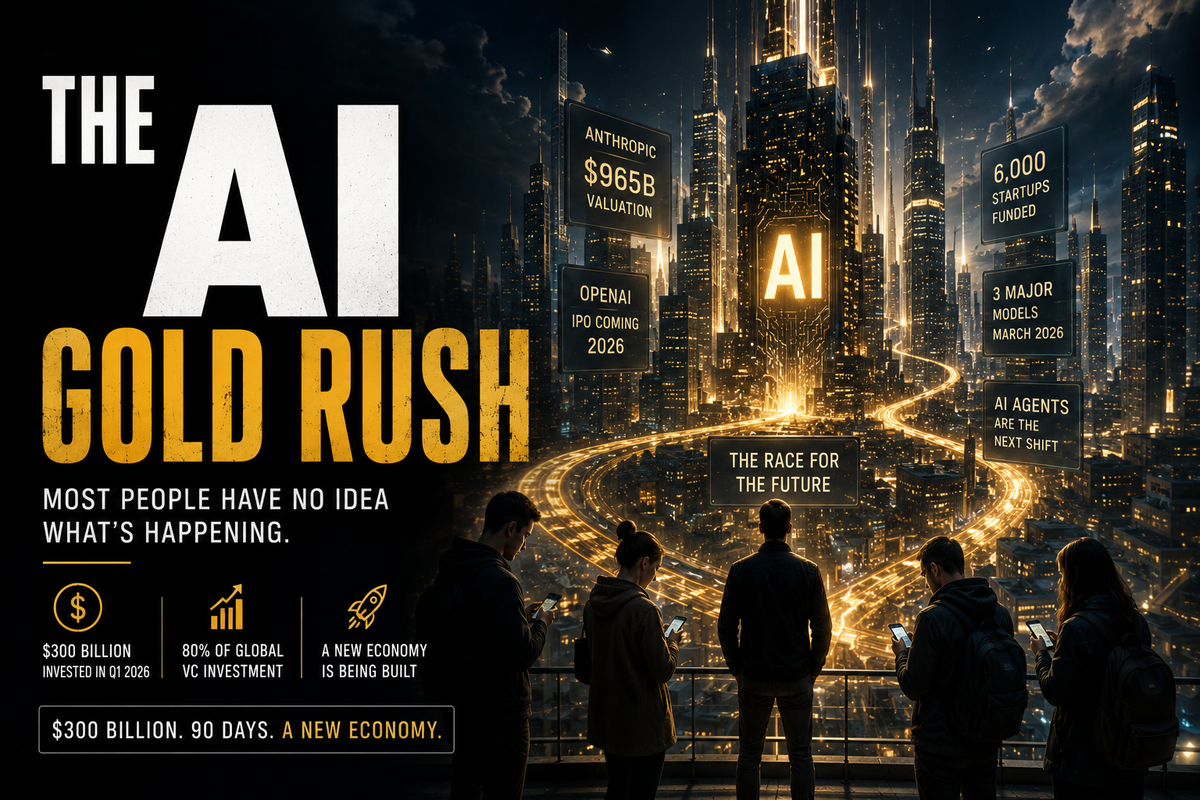
Let's start with the money, because that's where the scale of what's happening really hits you. In the first quarter of 2026 alone, investors poured roughly $300 billion into about 6,000 startups globally. Let that sit for a second. That's a single quarter — one 90-day window — that eclipses what used to be considered a strong full year of venture capital across all industries combined. AI accounted for approximately 80% of total global venture investment in Q1 2026, a figure that would have sounded like science fiction just two years ago. The money flowing into artificial intelligence has stopped looking like a trend and started looking like a complete reallocation of where the world's smartest investors believe the future is being built.
And it's not spread thin across thousands of small bets. Four deals alone made up nearly two-thirds of that capital — OpenAI closed a staggering round, Anthropic followed with a massive raise, xAI secured significant funding, and Waymo pulled in billions for self-driving technology. These aren't startups in the traditional sense anymore. These are companies being valued like nations, raising capital at a pace that makes traditional tech giants look slow by comparison.
The IPO race is where things get really interesting. For months, everyone assumed OpenAI would be the first major AI company to go public. They've been the loudest name in the space, the ones with the brand recognition, the ones everyone expected to lead. But in a move that caught much of the industry off guard, Anthropic — the company behind the Claude chatbot — filed confidentially for an initial public offering on June 1st, 2026, potentially beating OpenAI to Wall Street. Just days before the filing, Anthropic raised $65 billion in fresh funding at a $965 billion valuation, vaulting past OpenAI to become the most valuable AI startup in the world.
Think about what that means for a moment. A company that most everyday people still haven't heard of is now worth close to a trillion dollars. Not because of hype or marketing — but because the people and institutions who understand this technology the deepest are putting historic amounts of money behind it. Anthropic is reportedly on the verge of reporting its first quarter of operating profit, which is significant because it signals that this isn't just a "grow fast and figure out money later" play. There's real revenue, real demand, and real business fundamentals behind the valuation.
Meanwhile, OpenAI has been holding informal talks with banks about its own IPO, and the expectation is that both companies could be publicly traded before the end of 2026. We're watching the birth of what could become the most valuable companies in the world — in real time — and most people are too busy arguing about whether AI can write a good Instagram caption to notice.
Beyond the money, the technology itself is moving at a pace that's hard to overstate. In March 2026 alone, three major frontier models were released in a single month — new versions from OpenAI, Google, and xAI all launched within weeks of each other. The gap between what these companies can build is shrinking from months to weeks. The latest Stanford AI Index report showed that industry produced over 90% of notable frontier models in 2025, and several of those models now meet or exceed human performance on PhD-level science questions, advanced reasoning, and competition-level mathematics. On a major coding benchmark, performance jumped from 60% to near 100% in just one year.
That's not incremental improvement. That's a leap that fundamentally changes what AI can be trusted to do. When an AI system can reason through problems at the level of someone with a PhD, the conversations about "AI is just autocomplete" start to sound painfully outdated.
The shift toward AI agents is another massive development most people are sleeping on. The industry is moving beyond chatbots that answer questions toward systems that can actually do things — execute multi-step tasks, coordinate workflows, make decisions, and take actions without needing someone to hold their hand through every step. The Model Context Protocol crossed 97 million installs in March 2026, cementing it as foundational infrastructure for how AI systems connect to tools and data. The most credible signals heading into mid-2026 point to five major movements: agentic workflows, stronger reasoning, wider access to agent creation, AI-native software development, and a serious push into healthcare.
In practical terms, this means we're moving toward a world where AI doesn't just help you write an email — it sends the email, follows up, schedules the meeting that comes from it, prepares the brief for that meeting, and flags the key decisions you need to make. We're not fully there yet, but the infrastructure is being built right now, and the companies investing in it are being valued accordingly.
And then there's the adoption side. This isn't just a Silicon Valley story anymore. Organizational AI adoption has reached 88% globally, and four out of five university students now use generative AI regularly. Over half of companies surveyed said improved employee productivity was one of the biggest impacts AI had on their business operations. The telecoms industry is leading in agentic AI adoption, with 48% already implementing it, followed closely by retail. AI is no longer experimental. It's operational. Companies aren't asking "should we use AI" anymore — they're asking "how do we use it better and faster than our competitors."
What's particularly striking about this moment is the speed at which the competitive landscape is shifting. The U.S. and China have been trading the lead on AI capabilities multiple times since early 2025, with models from both countries taking turns at the top of global benchmarks. Anthropic's latest Claude model reportedly tops OpenAI's and Google's offerings on benchmarks for agentic coding, financial analysis, and computer use. But that lead could shift again next month. That's how fast things are moving.
So what does all of this mean for you? It means the AI industry isn't just growing — it's accelerating in a way that affects everyone, whether you work in tech or not. The companies being built right now will define the next decade of how we work, create, and make decisions. The tools being developed are already changing what one person can accomplish in a day. And the gap between people who understand what's happening and people who don't is widening every single week.
You don't need to invest in AI startups or understand every technical benchmark to benefit from this moment. But you do need to pay attention. Because the world that's being built right now — the one where AI agents manage workflows, where trillion-dollar companies are born in under five years, where machines reason at PhD level — that world isn't coming. It's already here. Most people just haven't looked up long enough to notice.
And by the time they do, the early movers will have already built an advantage that's very hard to catch.