How to Spot AI-Generated Content — And Why It Matters More Than You Think

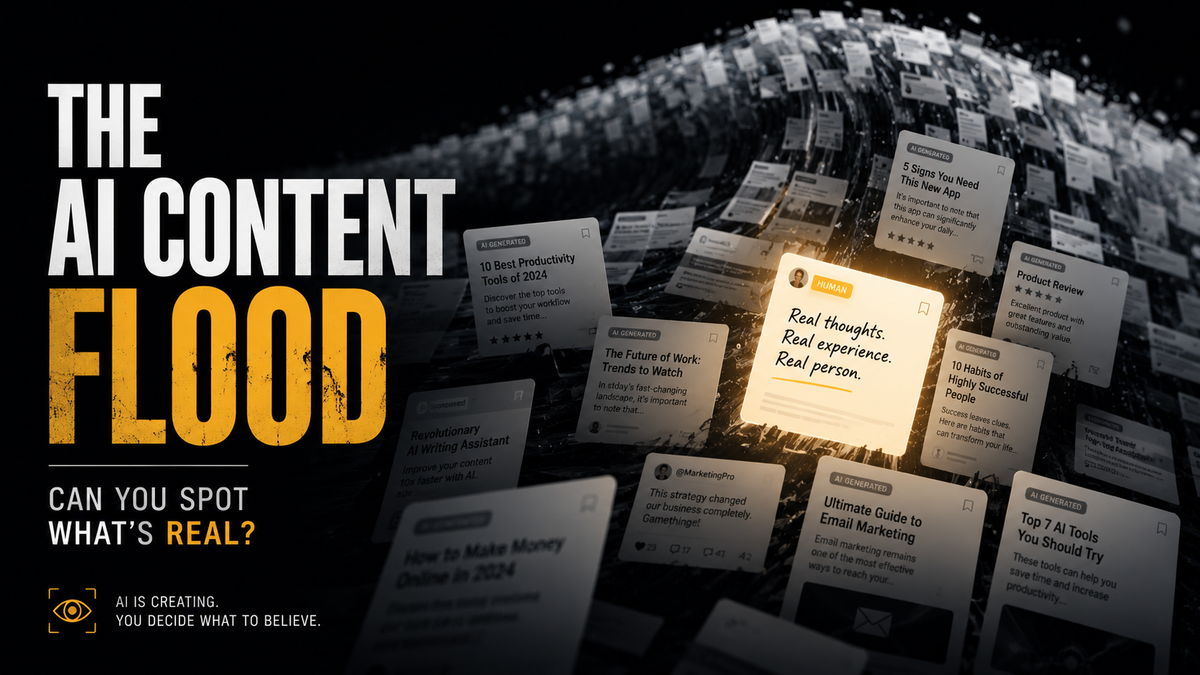
Something has quietly shifted on the internet over the last year or so, and most people haven't fully noticed it yet. A huge percentage of the content you're reading online right now — articles, social media posts, product reviews, even emails — wasn't written by a human. It was generated by AI, published without any disclosure, and designed to look and feel like it came from a real person with real opinions. And if that doesn't make you pause for a second, it probably should.
This isn't about demonising AI. AI is an incredible tool for creating content, and there's nothing inherently wrong with using it. The issue is when it's passed off as human thought without any transparency. Because when you read a product review that sounds genuine but was actually generated to push a sale, or an article that feels well-researched but was produced in thirty seconds with no real expertise behind it, you're making decisions based on something that was never really honest with you in the first place.
So how do you actually spot it? There are a few patterns that show up consistently once you know what to look for.
The first one is tone that feels just a little too perfect. AI-generated content tends to be very polished, very balanced, and almost unnervingly smooth. There are no rough edges. No personality quirks. No moments where the writing feels distinctly human — the kind of imperfections that come from someone actually thinking through their words instead of optimising them. If something reads like it was written by everyone and no one at the same time, there's a good chance it wasn't written by a person.
Then there's the structure problem. AI loves patterns. It loves lists, neat transitions, and wrapping things up with a tidy conclusion. You'll notice a lot of AI content follows an almost identical flow — broad opening, a few supporting points, a positive wrap-up. Every time. Real human writing is messier. It goes on tangents. It emphasises unexpected things. It doesn't always land perfectly. That messiness is actually what makes it trustworthy.
Another giveaway is depth without substance. AI is very good at sounding knowledgeable without actually saying anything new. It can write five paragraphs about a topic and when you finish reading, you realise you didn't actually learn anything you couldn't have guessed on your own. It's the illusion of insight without real insight. Human experts, on the other hand, tend to offer perspectives that surprise you, challenge you, or come from lived experience that AI simply cannot replicate.
There's also the vocabulary tell. AI tends to lean on certain words and phrases — "delve," "landscape," "it's important to note," "in today's world." These aren't words most people naturally use in casual writing. They're filler phrases that AI defaults to when bridging ideas. Once you start noticing them, you'll see them everywhere, and it becomes a pretty reliable signal.
Now here's why all of this actually matters beyond just being an interesting thing to know. Trust is the currency of the internet. When you read something, you're giving it a small piece of your attention and your belief. If the internet becomes so saturated with AI-generated content that you can't tell what's real and what's manufactured, that trust breaks down. People stop believing reviews. They stop trusting articles. They become cynical about everything they read — and that affects everyone, including the people who are genuinely creating honest, valuable content.
The solution isn't to reject AI content entirely. That ship has sailed. The solution is to become a smarter, more critical reader. Question what you read. Look for the patterns. Check whether the person behind the content actually exists and has real credentials. Pay attention to whether something is giving you genuine value or just filling space with words that sound good.
The people who develop this skill — the ability to filter signal from noise in an AI-saturated world — are going to have a serious advantage. Not just online, but in business, in decision-making, and in how they process information overall.
AI is an incredible tool for creating. But it's also made it more important than ever to think critically about what you consume.
That skill is worth developing now. Because the flood of AI content isn't slowing down — it's accelerating.