Claude Is More Powerful Than You Think — Here's What You're Missing

Most people hear "Claude" and think it's just another chatbot. You type something in, it types something back, and that's about it. Honestly, that's how most people use every AI tool — surface level. But Claude is quietly one of the most powerful AI models out there right now, and the gap between what it can do and what people actually use it for is massive.
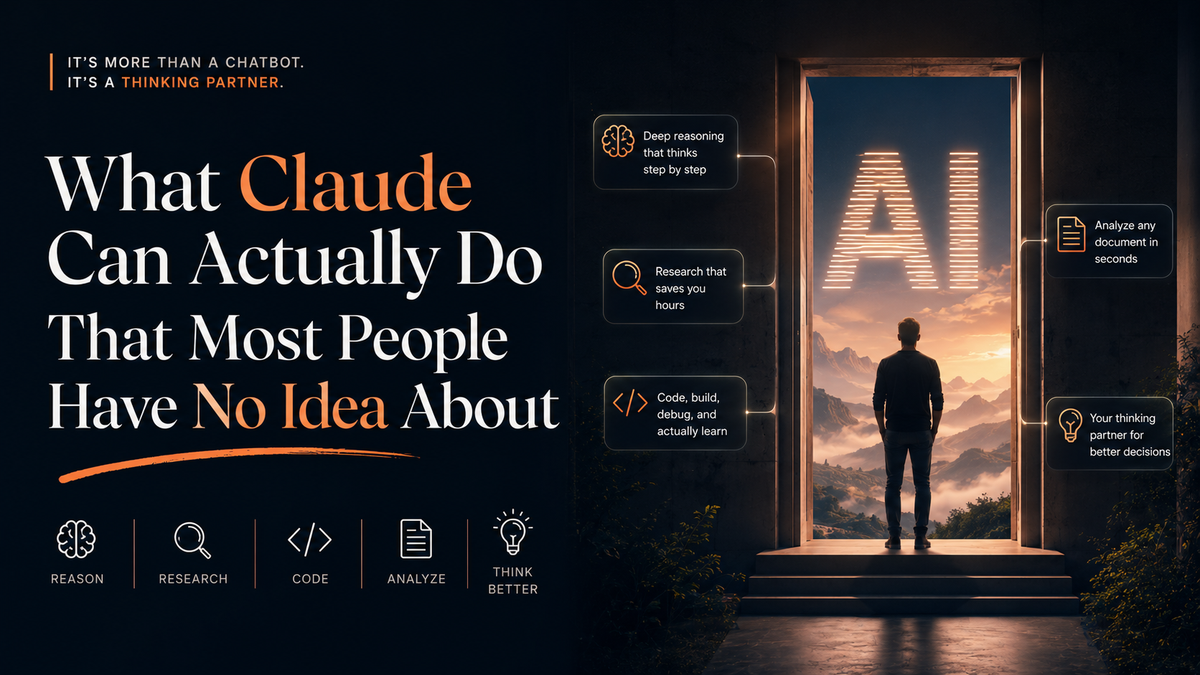
Let's start with something a lot of people overlook. Claude doesn't just answer your questions — it actually reasons through them. When you give it a complex problem, it doesn't just spit out the first response that sounds right. It thinks step by step, considers different angles, and walks you through its logic. That might sound like a small thing, but when you're making business decisions, analysing data, or trying to understand something complicated, that difference is everything.
Then there's research. Most people run to Google when they need to dig into a topic, open fifteen tabs, skim through articles, and try to piece it all together. Claude can do that heavy lifting for you in minutes. You give it a topic, tell it what you're trying to understand, and it pulls together a clear, structured breakdown that would have taken you hours to compile on your own. Not some shallow summary either — actual depth with nuance and context.
Here's another one that flies under the radar. Claude is genuinely good at writing code. Not just basic scripts either. Full applications, debugging, explaining what the code does in plain English so you actually learn from it. Developers are already using it as a serious working tool, not a gimmick. And if you're not a developer? That's almost more powerful — because now you can build things and automate tasks that previously required hiring someone.
What really sets Claude apart though is how it handles long, complex documents. You can feed it an entire report, a legal contract, a research paper — and it won't just skim it. It processes the whole thing and gives you a meaningful analysis. Summaries, key takeaways, potential issues, comparisons — whatever you need from that document, Claude can pull it out without you having to read every single page yourself.
And then there's something most people never even think to try. Using Claude as a thinking partner. Not just asking it to do tasks, but actually working through ideas with it. You can brainstorm a business strategy, pressure-test a plan, explore the pros and cons of a decision — and Claude will push back on weak thinking, offer perspectives you hadn't considered, and help you sharpen your ideas. It's like having a really sharp advisor available whenever you need one.
The thing is, none of this is hidden behind a paywall or some secret feature. It's all right there. Most people just never explore past the basics because they assume AI is all the same. It's not. And once you start using Claude for what it's actually capable of, it stops feeling like a chatbot and starts feeling like an unfair advantage.
The real question isn't whether AI is useful. It's whether you're using the right one — and using it properly.