AI Won't Take Your Job — But Someone Using AI Will

There's a conversation that keeps coming up every time AI makes a new leap forward. People start worrying about being replaced. Headlines fuel the panic. Social media does the rest. And suddenly everyone is either terrified of AI or pretending it doesn't matter. Both reactions miss the point entirely.
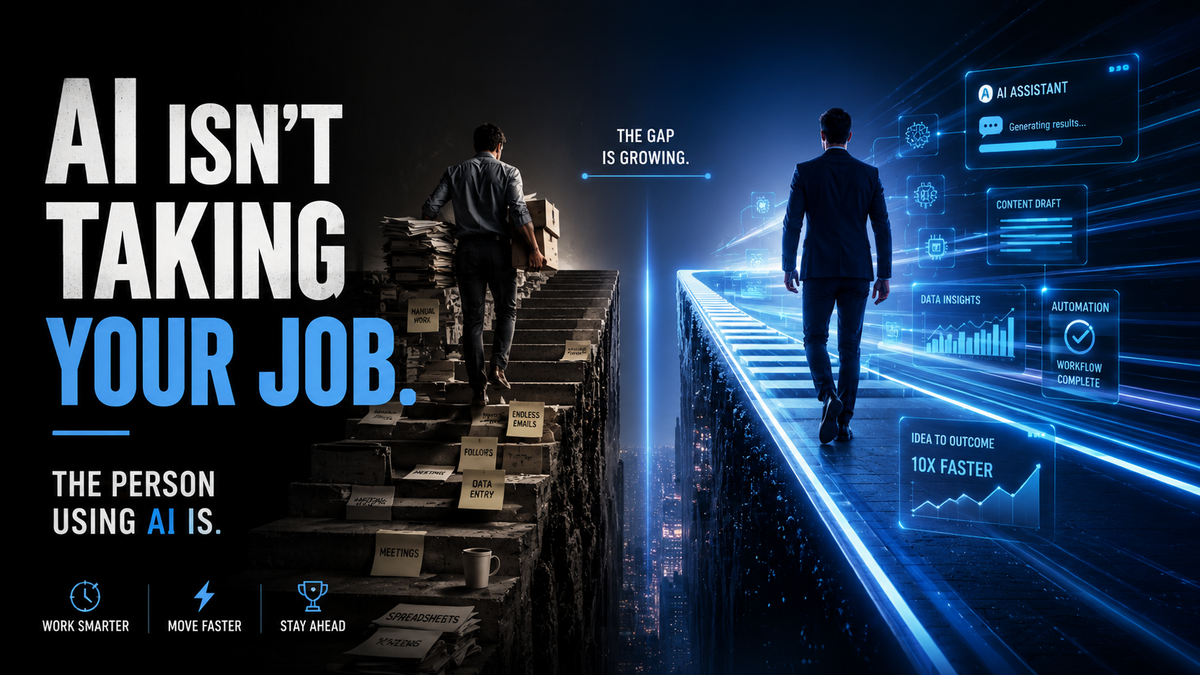
AI is not coming for your job. That's the truth. But here's the part most people aren't paying attention to — someone who knows how to use AI is coming for your job. And that's a very different kind of threat. It's not a robot sitting in your chair. It's a person just like you, doing the same role, but moving three times faster because they figured out how to let AI handle the parts that used to slow them down.
Think about it practically. Two marketers working at the same level. Same skills, same experience. One of them writes every email, every caption, every campaign brief from scratch. The other uses AI to generate first drafts, test variations, analyse what's working, and refine from there. That second marketer isn't less skilled — they're just less slow. They're producing more output, at a higher quality, in half the time. And when companies start noticing that gap, it's not hard to guess which one they'd rather keep around.
This isn't about any single industry either. It's happening everywhere. Designers are using AI to go from concept to mockup in minutes instead of days. Developers are writing and debugging code with AI assistance and shipping projects faster than entire teams used to. Writers are using AI to research, outline, and structure their work so they can spend their energy on the parts that actually require a human touch. The work isn't disappearing — it's being redistributed to people who adapt.
And that's really the key word here. Adapt. Not become an AI expert overnight. Not learn to code. Not abandon everything you know and start over. Just be willing to integrate AI into how you already work. That's the bar. And honestly, it's not a high one — but you'd be surprised how many people still refuse to even look at it because they think it's a phase or it doesn't apply to them.
Here's what makes this moment different from every other technology shift we've seen. AI doesn't just do one thing. It's not like learning a new software or switching to a new platform. It touches everything. How you write, how you research, how you plan, how you make decisions, how you communicate, how you build. It's not a tool that fits into one corner of your workflow — it reshapes the entire thing if you let it.
The people who will struggle aren't the ones with fewer skills. They're the ones who had every opportunity to evolve and chose not to. That sounds harsh, but it's the reality of every major shift in how work gets done. The internet didn't kill businesses — but businesses that ignored the internet got killed. Social media didn't end traditional marketing — but marketers who refused to learn it got left behind. AI is the same story, just moving faster.
The good news? You're still early. We're in that window where learning AI and weaving it into your daily work still puts you ahead of most people. That window won't stay open forever though. The gap between those who use AI and those who don't is growing every single month, and the longer someone waits, the harder it becomes to catch up.
So the question isn't whether AI will replace you. It won't. The question is whether you're going to be the person who uses it — or the person who gets outpaced by someone who does.
That's not a future problem. That's a right now problem.